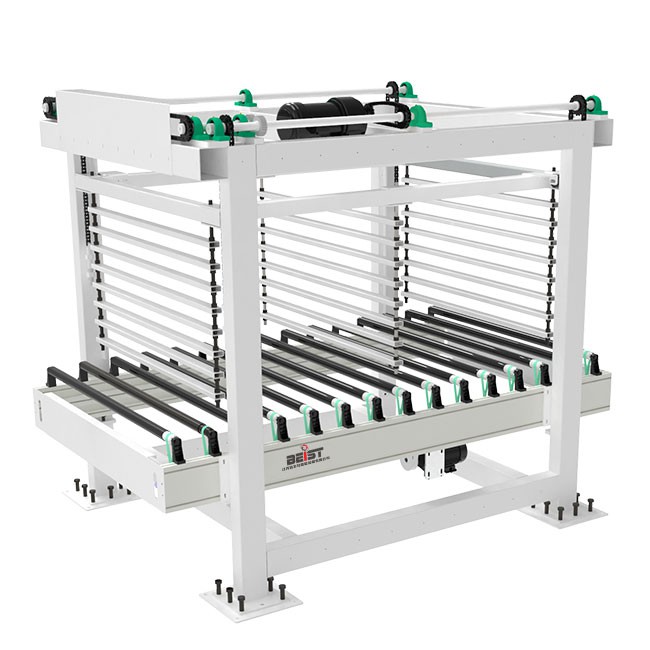
As a supplier of Powered Roller Conveyor - Lean, I often encounter inquiries from customers about the maximum length of these conveyors. This topic is crucial as it directly impacts the efficiency and feasibility of various industrial applications. In this blog, I will delve into the factors that determine the maximum length of a Powered Roller Conveyor - Lean and provide insights based on our experience in the industry.
Understanding Powered Roller Conveyor - Lean
Before discussing the maximum length, it's essential to understand what a Powered Roller Conveyor - Lean is. These conveyors are designed to move goods efficiently along a production line or within a warehouse. They consist of a series of rollers powered by motors, which provide the necessary force to transport items. The "Lean" aspect typically refers to a design that emphasizes simplicity, efficiency, and cost - effectiveness.
Factors Affecting the Maximum Length
1. Power Transmission
One of the primary factors influencing the maximum length of a Powered Roller Conveyor - Lean is the power transmission system. The motors used to drive the rollers must be able to supply sufficient torque to move the load along the entire length of the conveyor. As the length of the conveyor increases, the resistance to movement also increases due to factors such as friction between the rollers and the conveyed items, as well as the weight of the conveyor structure itself.


For example, if a conveyor is too long and the motor is not powerful enough, the rollers may start to slow down or even stop, leading to inefficiencies in the production process. Therefore, when determining the maximum length, it's crucial to select a motor with an appropriate power rating based on the expected load and conveyor length.
2. Roller Design and Spacing
The design and spacing of the rollers also play a significant role in determining the maximum length of the conveyor. Rollers with a larger diameter and higher quality bearings can reduce friction and improve the overall efficiency of the conveyor. Additionally, the spacing between the rollers should be carefully considered. If the rollers are too far apart, the conveyed items may not be supported properly, leading to uneven movement and potential damage.
On the other hand, if the rollers are too close together, the cost of the conveyor may increase significantly. A proper balance must be struck to ensure that the rollers can support the load effectively while also maintaining an efficient and cost - effective design.
3. Load Characteristics
The type, weight, and size of the items being conveyed are important factors in determining the maximum length of the conveyor. Heavy or large items require more power to move and may put more stress on the conveyor structure. For instance, if a conveyor is used to transport large pallets of heavy goods, the maximum length may be limited compared to a conveyor used for lighter, smaller items.
Moreover, the shape and surface characteristics of the conveyed items can also affect the conveyor's performance. Items with irregular shapes or rough surfaces may cause more friction and require additional power to move.
4. Conveyor Structure and Support
The structure and support of the conveyor are essential for maintaining its stability and integrity over long lengths. A well - designed conveyor frame made of high - quality materials can withstand the forces exerted during operation. Additionally, proper support along the length of the conveyor, such as legs or brackets, is necessary to prevent sagging or deformation.
If the conveyor structure is not strong enough, it may lead to misalignment of the rollers, which can cause the conveyed items to veer off course or even jam the conveyor. Therefore, the maximum length of the conveyor must be determined based on the strength and stability of its structure.
Typical Maximum Lengths and Real - World Examples
In general, the maximum length of a Powered Roller Conveyor - Lean can vary widely depending on the factors mentioned above. In some cases, for light - duty applications with small, lightweight items, a conveyor can be up to 50 meters or more in length. For example, in a small - scale electronics assembly line, where small components are being transported, a conveyor of this length can be effectively used.
However, for heavy - duty applications with large, heavy items, the maximum length may be significantly shorter, typically around 10 - 20 meters. For instance, in a steel manufacturing plant where large steel bars are being transported, the conveyor length is limited to ensure that the motors can provide enough power to move the heavy load.
Let's take a look at some real - world examples of how different conveyor types can be used in various applications. The Carbon Steel Belt Conveyor is often used in applications where a smooth and continuous surface is required for conveying items. It can be designed to have a relatively long length, depending on the power and support systems in place.
The Chain Driven Live Roller Conveyor is suitable for heavy - duty applications. Its chain - driven system provides high torque, allowing it to move heavy loads over a reasonable distance. However, due to the nature of the chain drive and the associated wear and tear, the maximum length may be somewhat limited compared to other types of conveyors.
The 90 Degree Cone - roller Type Turning Machine is a specialized conveyor component that can be used to change the direction of the conveyed items. When incorporated into a Powered Roller Conveyor - Lean system, it can add complexity to the design, but it also allows for more flexible layout options.
Designing for Longer Conveyors
If you require a longer Powered Roller Conveyor - Lean, there are several strategies that can be employed. One approach is to use multiple motors along the length of the conveyor. By dividing the conveyor into sections and powering each section with its own motor, the overall power requirements can be distributed more evenly, allowing for a longer conveyor length.
Another strategy is to optimize the roller design and spacing to reduce friction and improve efficiency. Using high - quality bearings and selecting the appropriate roller diameter and spacing can significantly enhance the conveyor's performance.
Contact Us for Your Conveyor Needs
If you are considering a Powered Roller Conveyor - Lean for your industrial application, it's important to work with a reliable supplier who can provide expert advice and customized solutions. As a leading supplier in the industry, we have the experience and knowledge to design and manufacture conveyors that meet your specific requirements.
Whether you need a short conveyor for a small - scale operation or a long conveyor for a large - scale production line, we can help. Our team of engineers will work closely with you to understand your needs, consider all the relevant factors, and design a conveyor that maximizes efficiency and productivity.
Don't hesitate to contact us to discuss your conveyor project. We look forward to partnering with you to create the perfect conveyor solution for your business.
References
- "Conveyor Systems Handbook" by Material Handling Industry of America
- "Industrial Conveyor Design Manual" by CEMA (Conveyor Equipment Manufacturers Association)