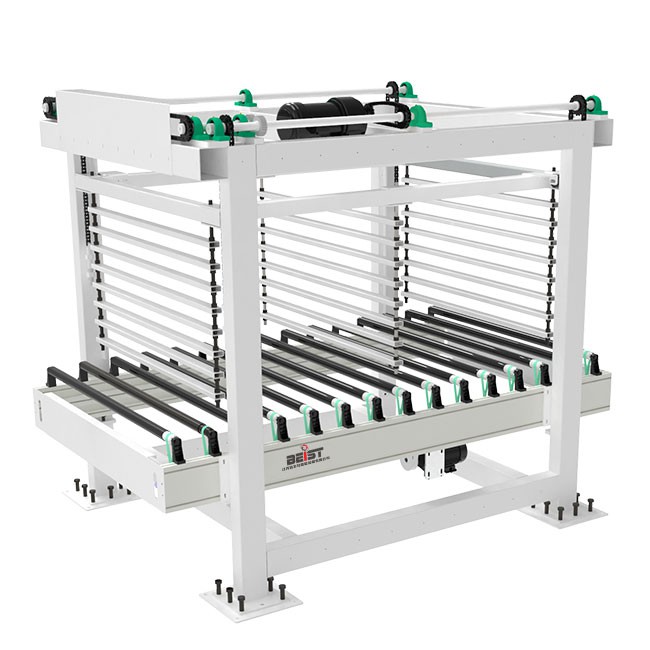
Hey there! As a supplier of Conveyor Crossover Bridges, I've been getting a lot of questions lately about the seismic - response characteristics of these structures. So, I thought I'd take a deep dive into this topic and share what I know.
First off, let's understand what a Conveyor Crossover Bridge is. It's a crucial part of many industrial setups, allowing conveyors to cross over each other or other obstacles. This helps in optimizing the layout of a factory or a mining site, for example. Now, when it comes to seismic events, these bridges need to be able to withstand the forces generated by earthquakes.
One of the key seismic - response characteristics of a Conveyor Crossover Bridge is its flexibility. You see, during an earthquake, the ground shakes in all sorts of directions. A bridge that's too rigid is more likely to crack or even collapse under the stress. On the other hand, a flexible bridge can bend and sway with the seismic waves. This flexibility is achieved through careful design, using materials that can absorb and dissipate the energy from the earthquake.
For instance, we often use high - strength steel in our Conveyor Crossover Bridges. Steel has excellent ductility, which means it can stretch and deform without breaking easily. This property allows the bridge to adapt to the movements during an earthquake. We also use special joints and connections that can flex and rotate, further enhancing the bridge's ability to respond to seismic forces.


Another important characteristic is the bridge's natural frequency. Every structure has a natural frequency at which it tends to vibrate. If the frequency of the seismic waves matches the natural frequency of the bridge, it can lead to resonance. Resonance is a big problem because it can cause the bridge to vibrate with increasing amplitude, potentially leading to failure.
To avoid resonance, we design our Conveyor Crossover Bridges with a natural frequency that is well - separated from the typical frequencies of seismic waves. This is done through a combination of structural design and the use of dampers. Dampers are devices that absorb energy and reduce the amplitude of vibrations. They can be hydraulic, viscous, or friction - based, depending on the specific requirements of the bridge.
The mass distribution of the bridge also plays a significant role in its seismic response. A bridge with an uneven mass distribution can experience uneven forces during an earthquake, which can lead to stress concentrations and potential failure. We carefully calculate and balance the mass of different components of the bridge, such as the conveyor belts, support structures, and any attached equipment. This ensures that the forces are distributed more evenly during a seismic event.
Now, let's talk about some of the related products that can work in tandem with our Conveyor Crossover Bridges. We offer a range of unpowered roller conveyors, like the Gravity Roller Conveyor. These conveyors are simple yet effective, using gravity to move materials along the conveyor line. They can be easily integrated with our Conveyor Crossover Bridges, providing a seamless material handling solution.
Another great product is the Conveyor Platform for Cold Press. This platform is designed to work with cold - press machines, ensuring smooth and efficient material transfer. It can be connected to the Conveyor Crossover Bridge, creating a comprehensive material handling system.
And then there's the Transfer Cart with Turntable. This cart is ideal for moving materials between different areas of a facility. It can be used in combination with our Conveyor Crossover Bridges to transport materials across different levels or sections of a factory.
When it comes to seismic - response testing, we put our Conveyor Crossover Bridges through rigorous simulations and real - world tests. We use advanced computer models to simulate different earthquake scenarios and analyze how the bridge will respond. We also conduct full - scale testing in specialized facilities, where we can subject the bridge to controlled seismic forces. This allows us to fine - tune the design and ensure that the bridge meets the highest safety standards.
In conclusion, understanding the seismic - response characteristics of a Conveyor Crossover Bridge is crucial for ensuring its safety and reliability. Our team of experts works hard to design and build bridges that can withstand seismic events. Whether you're in the mining, manufacturing, or any other industry that requires efficient material handling, our Conveyor Crossover Bridges and related products can provide a solution.
If you're interested in learning more about our Conveyor Crossover Bridges or any of our other products, or if you're looking to start a procurement discussion, don't hesitate to reach out. We're always happy to talk about your specific needs and find the best solution for your business.
References
- "Seismic Design of Industrial Structures" - A comprehensive guide on seismic design principles for various industrial structures.
- "Steel Structures in Earthquake - Prone Areas" - Research on the behavior of steel structures during earthquakes and design considerations.