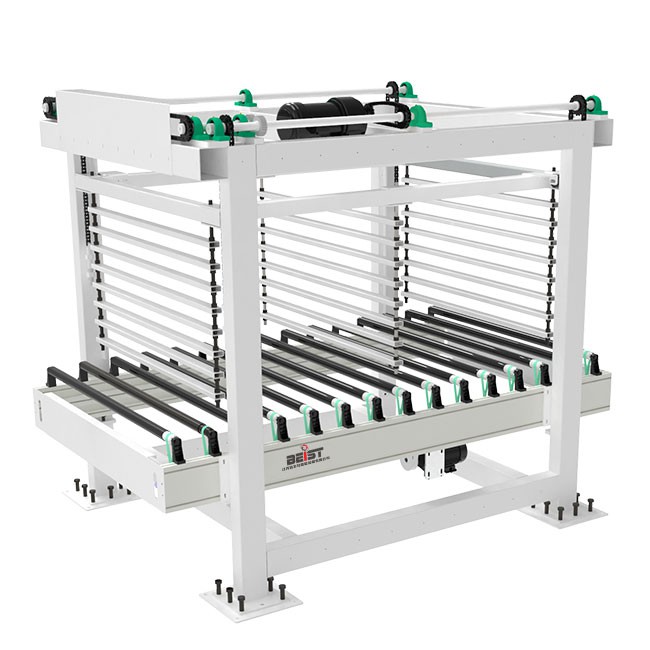
Hey there! As a supplier of Cross Conveyors, I'm super stoked to break down the working principle of these nifty machines for you. Cross conveyors are pretty cool because they can move stuff in different directions, making them a real game - changer in all sorts of industries.
Let's start with the basics. A cross conveyor is a type of conveyor system that can transfer items from one conveyor line to another at a right - angle or other angles. It's like a traffic intersection for your goods, allowing them to change directions smoothly and efficiently.
The main components of a cross conveyor usually include a frame, rollers, a drive system, and some sort of control mechanism. The frame is the backbone of the conveyor. It provides support and stability for all the other parts. It's typically made of strong materials like steel or aluminum to handle the weight of the items being transported.
Rollers are another crucial part. They're what actually move the items along the conveyor. There are different types of rollers, such as powered rollers and idler rollers. Powered rollers have a motor attached to them, which gives them the power to rotate and move the items forward. Idler rollers, on the other hand, don't have their own power source. They just spin freely as the items pass over them, helping to support and guide the movement.
The drive system is responsible for making the powered rollers turn. There are a few different ways to power the rollers. One common method is using a belt drive. In a belt - driven system, a belt is wrapped around the rollers and connected to a motor. When the motor turns, it makes the belt move, which in turn rotates the rollers. Another option is a chain drive. Chain drives work in a similar way, but instead of a belt, a chain is used to transfer the power from the motor to the rollers.
Now, let's talk about how the cross - transfer function works. When an item reaches the point where it needs to change directions, there are a few different techniques that can be used. One popular method is using a cone - roller type turning mechanism. You can check out more about the 90 Degree Cone - roller Type Turning Machine. In this system, the rollers at the transfer point are shaped like cones. As the item moves onto these cone - shaped rollers, the difference in the diameter of the cones causes the item to start turning. This allows it to smoothly transition from one conveyor line to another at a right - angle.
Another way to achieve cross - transfer is through the use of a powered roller conveyor. The Powered Roller Conveyor can be configured in such a way that the rollers can be angled or controlled to direct the item in a different direction. For example, some powered roller conveyors can have individual zones that can be independently controlled. When an item reaches a specific zone, the rollers in that zone can be made to rotate in a different direction, guiding the item onto the new conveyor line.
Control is also a key aspect of a cross conveyor. A control mechanism is used to manage the speed, direction, and timing of the conveyor. This can be as simple as a basic on - off switch, or it can be a more complex programmable logic controller (PLC). A PLC allows for precise control of the conveyor system. It can be programmed to start and stop the conveyor at specific times, adjust the speed based on the type of item being transported, and coordinate the movement between different conveyor sections.
In some industrial settings, cross conveyors are often integrated with other types of equipment. For instance, a Fully Automatic Gantry Manipulator can be used in conjunction with a cross conveyor. The gantry manipulator can pick up items from one conveyor, move them to the cross conveyor, and then place them on another conveyor at the desired location. This kind of integration can greatly increase the efficiency of the overall production or distribution process.
Cross conveyors are used in a wide range of industries. In the manufacturing industry, they're used to move parts between different production stations. For example, in an automotive assembly line, cross conveyors can transfer engine components from one assembly area to another. In the warehousing and logistics industry, cross conveyors are used to sort and distribute packages. They can quickly move packages from one conveyor belt to another, depending on their destination.
One of the big advantages of cross conveyors is their flexibility. They can be customized to fit the specific needs of different applications. You can choose the size, shape, and configuration of the conveyor based on the size and type of items you need to transport. You can also select different types of rollers, drive systems, and control mechanisms to optimize the performance of the conveyor.
Another advantage is their efficiency. By allowing items to change directions smoothly, cross conveyors can reduce the time and effort required to move goods around a facility. This can lead to increased productivity and lower operating costs.


However, like any piece of equipment, cross conveyors also have some challenges. Maintenance is an important consideration. The rollers, belts, and chains need to be regularly inspected and lubricated to ensure smooth operation. If a component fails, it can cause downtime and disrupt the production process. Also, the initial cost of purchasing and installing a cross conveyor can be relatively high. But when you consider the long - term benefits in terms of increased efficiency and productivity, it's often a worthwhile investment.
So, if you're in an industry that requires the movement and transfer of goods, a cross conveyor could be a great solution for you. Whether you're a small - scale manufacturer or a large - scale logistics provider, we can offer a cross conveyor system that meets your specific requirements.
If you're interested in learning more about our cross conveyors or want to discuss a potential purchase, don't hesitate to reach out. We're here to answer any questions you might have and help you find the best conveyor solution for your business. Let's have a chat and see how we can work together to improve your operations.
References
- General knowledge of conveyor systems from industry experience.
- Information about conveyor components and functions from industry - specific literature.