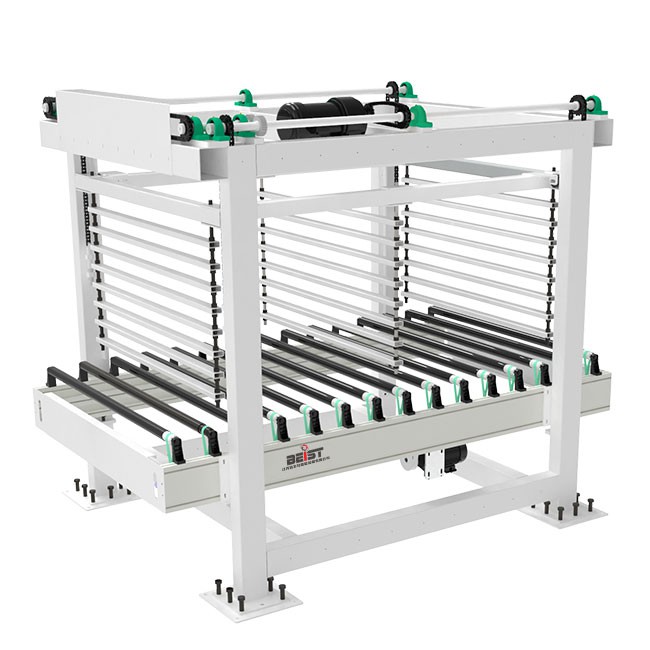
In the realm of material handling, gravity skate wheel conveyors have long been a staple due to their simplicity, cost - effectiveness, and ease of installation. As a supplier of Gravity Skate Wheel Conveyors, I've had numerous inquiries regarding their performance in various environments, and one question that often arises is: What is the performance of a Gravity Skate Wheel Conveyor in a windy environment?
How Gravity Skate Wheel Conveyors Work
Before delving into the impact of wind, it's essential to understand the basic principles of a gravity skate wheel conveyor. These conveyors operate on the principle of gravity, using a series of skate wheels mounted on a frame. When a load is placed on the conveyor at a higher elevation, the force of gravity causes it to move down the slope along the skate wheels. The smooth rotation of the skate wheels minimizes friction, allowing the load to move efficiently.


Wind as an External Factor
Wind can act as an external force that significantly affects the performance of a gravity skate wheel conveyor. There are two main scenarios to consider: headwinds and cross - winds.
Headwinds
A headwind is a wind that blows directly against the direction of the load's movement on the conveyor. When a headwind is present, it creates a resistive force that opposes the motion of the load. This resistive force can slow down the movement of the load on the conveyor.
For light - weight loads, a relatively gentle headwind can cause the load to come to a complete stop. For example, if you're conveying small, lightweight packages such as envelopes or thin cardboard boxes, a headwind of just a few miles per hour can disrupt the normal flow. The force exerted by the headwind on the load can be calculated using the drag force formula (F_d=\frac{1}{2}\rho v^{2}C_dA), where (\rho) is the air density, (v) is the wind speed, (C_d) is the drag coefficient of the load, and (A) is the cross - sectional area of the load facing the wind.
In a warehouse or industrial setting where the conveyor is used to move products continuously, a headwind can lead to bottlenecks. Products may stack up at the start of the conveyor, causing inefficiencies in the material handling process. To counteract the effects of a headwind, one option is to increase the slope of the conveyor. By increasing the slope, the gravitational force acting on the load is increased, which can help overcome the resistive force of the headwind. However, increasing the slope too much can also lead to other problems, such as the load moving too fast and potentially falling off the conveyor.
Cross - winds
Cross - winds blow perpendicular to the direction of the load's movement on the conveyor. A cross - wind can cause the load to deviate from its intended path. This is particularly problematic for loads that have a high center of gravity or are irregularly shaped.
For instance, if you're conveying tall and narrow objects like poles or pipes, a cross - wind can cause them to tip over. The lateral force exerted by the cross - wind on the load can be calculated using a similar drag force formula as for headwinds. To mitigate the effects of cross - winds, side guides can be installed on the conveyor. Side guides act as barriers that prevent the load from deviating too far from the center of the conveyor. They can be made of various materials, such as metal or plastic, and are typically adjustable to accommodate different load sizes.
Impact on Conveyor Components
In addition to affecting the movement of the load, wind can also have an impact on the conveyor components themselves. Strong winds can cause vibrations in the conveyor frame, which can lead to premature wear and tear of the skate wheels and other moving parts.
The constant shaking can loosen the connections between the skate wheels and the frame, potentially leading to wheel misalignment. Misaligned skate wheels can increase friction, which in turn reduces the efficiency of the conveyor. To prevent this, it's important to ensure that the conveyor is properly installed and secured. Using vibration - dampening mounts can help absorb the vibrations caused by the wind and protect the conveyor components.
Solutions and Adaptations
As a supplier of Gravity Skate Wheel Conveyors, I've seen various solutions that customers have implemented to deal with windy environments. One effective solution is to enclose the conveyor. By enclosing the conveyor in a tunnel - like structure, the wind is blocked from directly affecting the load and the conveyor components. This can be especially useful in outdoor settings or large, open - air warehouses where wind is more prevalent.
Another option is to use powered assist devices in combination with the gravity skate wheel conveyor. For example, adding small electric motors at strategic points along the conveyor can provide an extra boost to the load, helping it overcome the resistive force of the wind. These powered assist devices can be controlled automatically based on the wind speed and the movement of the load.
Related Conveyor Products
If you're considering a conveyor system for your specific application, we also offer a range of related products. Check out our Unpowered Roller Conveyor, which provides a different approach to material handling with its roller - based design. Our Conveyor Platform for Cold Press is specifically designed for use in cold press applications, offering reliable performance in demanding environments. And for sorting operations, our Sorting Roller Conveyor can be a great choice, allowing for efficient sorting of products.
Conclusion
In conclusion, the performance of a Gravity Skate Wheel Conveyor in a windy environment can be significantly affected by headwinds and cross - winds. Headwinds can slow down or even stop the movement of the load, while cross - winds can cause the load to deviate from its path. Wind can also have an impact on the conveyor components, leading to premature wear and tear. However, with proper solutions such as increasing the slope, installing side guides, enclosing the conveyor, or using powered assist devices, these challenges can be overcome.
If you're interested in learning more about how our Gravity Skate Wheel Conveyors can perform in your specific environment or if you're looking to purchase a conveyor system, please feel free to contact us for a detailed consultation. We're here to help you find the best material handling solution for your needs.
References
- "Fluid Mechanics" by Frank M. White
- "Material Handling Handbook" by the Material Handling Institute of America