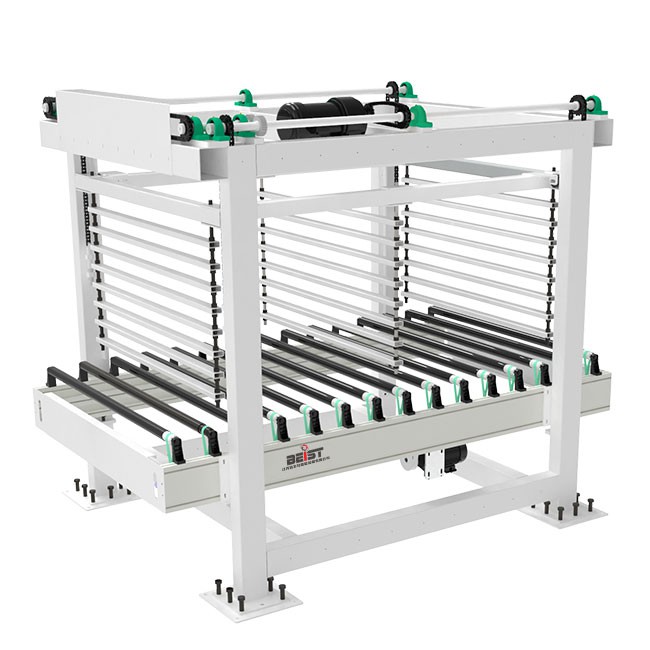
Hey there! As a supplier of Gravity Roller Conveyors, I often get asked about how to select the right motor for a semi-powered gravity roller conveyor. It's a crucial decision that can significantly impact the efficiency and performance of your conveyor system. So, let's dive into this topic and break it down step by step.
Understanding the Basics of Semi-Powered Gravity Roller Conveyors
First things first, let's quickly go over what a semi-powered gravity roller conveyor is. Unlike a fully powered conveyor that uses motors to move items continuously, a semi-powered gravity roller conveyor combines the benefits of gravity and motor assistance. Gravity helps move the items along the rollers, and the motor is used to provide an extra push when needed, like on inclines or to overcome friction.
These conveyors are great for a variety of applications, from warehouses to manufacturing plants. They're cost-effective, energy-efficient, and can handle different types of loads. But to get the most out of them, you need to choose the right motor.
Factors to Consider When Selecting a Motor
Load Capacity
The first thing you need to think about is the load capacity of your conveyor. How heavy are the items you'll be moving? You need a motor that can handle the weight without overworking. If the motor is too small, it won't be able to move the load, and it might burn out quickly. On the other hand, a motor that's too big will waste energy and cost you more money.
To determine the load capacity, you need to know the maximum weight of the items you'll be transporting and how many items will be on the conveyor at the same time. You can then use this information to calculate the required motor power.
Conveyor Speed
Another important factor is the conveyor speed. How fast do you need the items to move? The speed of the conveyor will depend on your production requirements. If you need to move a large number of items quickly, you'll need a motor that can provide a higher speed. However, keep in mind that increasing the speed also increases the power requirements.
You can usually adjust the speed of the conveyor using a variable frequency drive (VFD). This allows you to control the motor speed and optimize it for your specific needs.
Incline and Decline
If your conveyor has an incline or decline, you'll need to take this into account when selecting a motor. Moving items uphill requires more power than moving them on a flat surface. The steeper the incline, the more power the motor will need.
On the other hand, moving items downhill can be a bit tricky. You don't want the items to move too fast and cause damage. In this case, you might need a motor that can provide some braking force to control the speed.
Environment
The environment in which the conveyor will be used is also an important consideration. If the conveyor will be in a dusty or dirty environment, you'll need a motor that's protected against dust and debris. Similarly, if the conveyor will be in a wet or corrosive environment, you'll need a motor that's waterproof and corrosion-resistant.
Cost
Of course, cost is always a factor. You want to find a motor that meets your requirements without breaking the bank. However, don't just go for the cheapest option. A low-quality motor might save you money upfront, but it could end up costing you more in the long run due to maintenance and replacement costs.
Types of Motors for Semi-Powered Gravity Roller Conveyors
AC Motors
AC motors are the most common type of motor used in conveyor systems. They're reliable, efficient, and relatively inexpensive. AC motors come in different sizes and power ratings, so you can easily find one that suits your needs.
One of the advantages of AC motors is that they can be easily controlled using a VFD. This allows you to adjust the speed and torque of the motor to optimize the performance of your conveyor.
DC Motors
DC motors are another option for semi-powered gravity roller conveyors. They're known for their high torque and precise speed control. DC motors are often used in applications where you need to start and stop the conveyor quickly or where you need to control the speed very accurately.
However, DC motors are more expensive than AC motors, and they require a more complex control system. They also have a shorter lifespan than AC motors, so you'll need to replace them more often.
Servo Motors
Servo motors are a type of DC motor that's designed for high-precision applications. They're very accurate and can provide precise control over the speed and position of the conveyor. Servo motors are often used in applications where you need to move items with a high degree of accuracy, such as in robotics or automation.
However, servo motors are the most expensive type of motor, and they require a sophisticated control system. They're also more complex to install and maintain than AC or DC motors.
Comparing Different Conveyor Types
When it comes to conveyor systems, there are several types to choose from. Here are a few other options you might want to consider:
- Air Flotation Table Conveyor: This type of conveyor uses air to float the items along the surface, reducing friction and allowing for smooth and efficient movement.
- Pneumatic Roller Conveyor: Pneumatic roller conveyors use compressed air to power the rollers, providing a reliable and energy-efficient solution for moving items.
- Ball Transfer Table Conveyor: Ball transfer table conveyors use small balls to allow for easy movement of items in multiple directions. They're often used in applications where you need to change the direction of the items quickly.
Each type of conveyor has its own advantages and disadvantages, so it's important to choose the one that's best suited for your specific needs.
Conclusion
Selecting the right motor for a semi-powered gravity roller conveyor is a critical decision that can have a big impact on the performance and efficiency of your conveyor system. By considering factors such as load capacity, conveyor speed, incline and decline, environment, and cost, you can choose a motor that meets your requirements and provides reliable and efficient operation.
If you're still not sure which motor is right for you, don't hesitate to contact us. Our team of experts can help you evaluate your needs and recommend the best motor for your semi-powered gravity roller conveyor. We're here to make sure you get the most out of your conveyor system.


So, if you're in the market for a semi-powered gravity roller conveyor or need help selecting the right motor, give us a call or send us an email. We'd love to discuss your options and help you find the perfect solution for your business.
References
- Conveyor Handbook, 3rd Edition
- Industrial Motor Selection Guide
- Motor and Drive Technology for Conveyor Systems