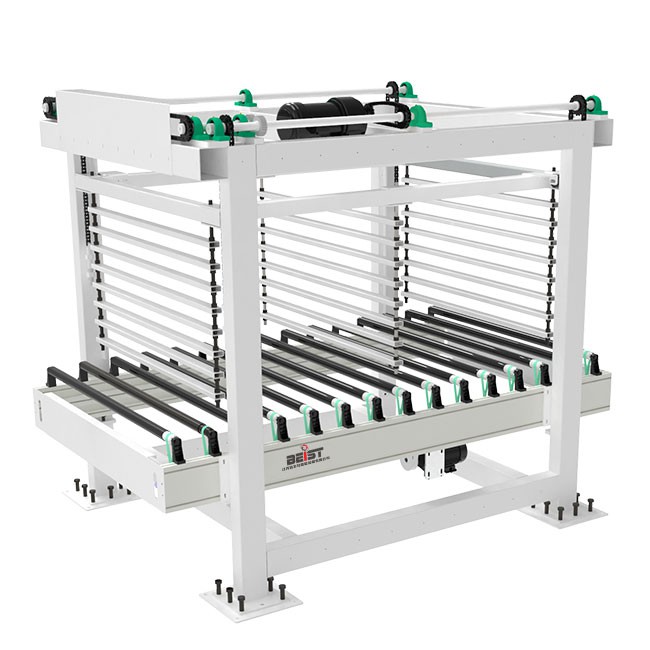
As a supplier of Automatic Flip Machines, I've been frequently asked whether these machines can be used for non - standard products. In this blog, I'll delve into this topic and analyze the viability of using an Automatic Flip Machine for such items.
Understanding Automatic Flip Machines
An Automatic Flip Machine is a sophisticated piece of equipment often integrated into conveyor systems. Its primary function is to flip products as they move along the production or transportation line. This flipping action can serve multiple purposes, such as reorienting products for inspection, packaging, or further processing.


Standard Automatic Flip Machines are designed to handle products with regular shapes and sizes, like rectangular boxes, cylindrical cans, etc. These machines are calibrated with specific settings for speed, angle, and pressure based on the standard dimensions and weight of common products. For instance, a canning factory might use an Automatic Flip Machine to turn cans over before labeling. The machine is programmed to handle cans of a particular diameter and height, ensuring a smooth and efficient flipping process.
Challenges with Non - Standard Products
Non - standard products present a unique set of challenges when it comes to using an Automatic Flip Machine.
Shape Complexity: Products with irregular shapes, such as those with protruding parts, uneven surfaces, or complex geometries, can be difficult to grip and flip. The grippers or mechanisms in a standard Automatic Flip Machine are typically designed for smooth, regular objects. For example, a handmade ceramic vase with a bumpy texture and an irregular form may not be held securely by the standard gripping mechanism. As a result, there is a high risk of the product slipping or being damaged during the flipping process.
Size Variation: Non - standard products can also vary greatly in size. An Automatic Flip Machine set up for a specific product size may not be able to accommodate larger or smaller items. For instance, if a machine is calibrated for medium - sized boxes, trying to flip a very large or very small box could lead to improper flipping. A large box may not fit within the flipping area, and a small box may not be detected or held properly by the machine's sensors and grippers.
Weight Distribution: Uneven weight distribution in non - standard products can cause instability during the flipping process. A product that has most of its weight concentrated on one side may tip over or rotate in an unexpected manner. This can disrupt the production line and potentially damage the product or the machine itself.
Adaptability of Automatic Flip Machines
Despite these challenges, modern Automatic Flip Machines are becoming increasingly adaptable to non - standard products.
Customizable Gripping Mechanisms: Some manufacturers, including us, offer Automatic Flip Machines with adjustable or customizable grippers. These grippers can be modified to fit different shapes and sizes of products. For example, a set of flexible gripper pads can conform to the irregular surface of a product, providing a more secure grip. This allows the machine to handle a wider range of non - standard items without the need for extensive retooling.
Advanced Sensors and Controls: Many Automatic Flip Machines are now equipped with advanced sensors that can detect the shape, size, and weight of a product in real - time. These sensors send signals to the machine's control system, which then adjusts the flipping parameters accordingly. For instance, if a sensor detects a heavier or larger product, the machine can increase the gripping force and adjust the flipping speed to ensure a safe and accurate flip.
Integration with Other Conveyor Systems: Another aspect that enhances the adaptability of Automatic Flip Machines is their integration with other conveyor systems, such as Chain Driven Live Roller Conveyor and Powered Roller Conveyor - Gap. These conveyor systems can be used to pre - position non - standard products before they reach the Automatic Flip Machine. This helps in ensuring that the products are in the correct orientation and position, reducing the risk of flipping errors.
Real - World Applications
In various industries, Automatic Flip Machines are being successfully used for non - standard products.
Automotive Industry: In the automotive manufacturing process, there are many non - standard components, such as engine cylinders and transmission parts. Automatic Flip Machines with customized grippers and advanced controls can be used to flip these components for inspection, machining, or assembly. The ability to handle these non - standard items efficiently helps in improving the overall productivity of the manufacturing line.
Food Industry: The food industry also deals with a wide range of non - standard products, such as artisanal bread loaves and irregularly shaped pastries. Automatic Flip Machines can be used to turn these products over during the baking or packaging process. Customized grippers can be designed to handle the delicate nature of food products without causing damage.
Cost - Benefit Analysis
Using an Automatic Flip Machine for non - standard products may involve some additional costs. There may be a need for customization of the machine, which can include the design and installation of new gripping mechanisms and the calibration of sensors. Additionally, there may be some trial - and - error involved in finding the optimal settings for non - standard products.
However, the benefits can outweigh the costs in the long run. By using an Automatic Flip Machine for non - standard products, companies can increase their production efficiency, reduce manual labor, and improve product quality. The machine can work continuously without fatigue, ensuring a consistent flipping process. This can lead to higher output and fewer product defects, ultimately resulting in cost savings and increased profitability.
Contact for Procurement and Consultation
If you are considering using an Automatic Flip Machine for your non - standard products, I encourage you to reach out to us for more information. We have a team of experts who can provide you with detailed consultations on the feasibility, customization options, and cost - benefit analysis. Our goal is to help you find the best solution for your specific production needs. So, don't hesitate to start a conversation about how our Automatic Flip Machine can be tailored to handle your non - standard products.
References
- "Automation in Manufacturing: A Comprehensive Guide", Smith, John, Industrial Press, 2020.
- "Conveyor Systems and Their Applications", Brown, Emily, ConveyorTech Journal, 2021.
- "Innovations in Product Handling Equipment", Green, Robert, Manufacturing Today Magazine, 2022.