The maximum speed of an unpowered roller conveyor is a topic that often piques the interest of those in the material handling industry. As a supplier of unpowered roller conveyors, I have encountered numerous inquiries regarding this aspect. In this blog, I will delve into the factors that influence the maximum speed of an unpowered roller conveyor and provide insights based on industry knowledge and experience.
Understanding Unpowered Roller Conveyors
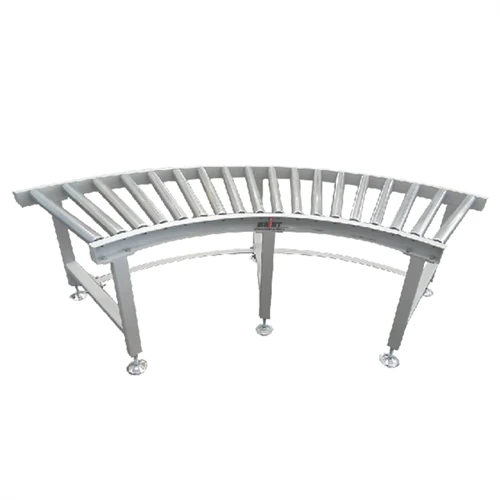
Unpowered roller conveyors, also known as gravity conveyors, rely on gravity to move items along the conveyor line. They are simple, cost - effective, and widely used in various industries for transporting goods. These conveyors consist of a series of rollers mounted on a frame, and the movement of the product is facilitated by the incline of the conveyor or the initial push given to the item.
Factors Affecting the Maximum Speed
Conveyor Incline
The incline of the unpowered roller conveyor is one of the most significant factors influencing the maximum speed. A steeper incline will generally result in a higher speed as the force of gravity acting on the product is greater. However, there are limitations to how steep the incline can be. If the incline is too steep, the product may move too quickly, causing it to become unstable, potentially leading to damage or derailment. For most applications, an incline of 2 - 5 degrees is common, but this can vary depending on the type of product being transported.
Product Characteristics
The weight, size, and shape of the product being conveyed play a crucial role in determining the maximum speed. Heavier products will generally move faster down the conveyor due to the greater gravitational force acting on them. However, if the product is too heavy, it may put excessive stress on the rollers and the conveyor frame. Similarly, products with irregular shapes may not move smoothly along the conveyor, which can limit the speed. For example, a long and thin item may be more prone to tipping over compared to a compact and well - balanced product.
Roller Design and Quality
The design and quality of the rollers have a direct impact on the maximum speed of the conveyor. High - quality rollers with low friction bearings will allow the product to move more smoothly and at a higher speed. The diameter and spacing of the rollers also matter. Larger diameter rollers can support heavier loads and may allow for faster movement, while proper roller spacing ensures that the product is well - supported throughout its journey on the conveyor.
Surface Conditions
The surface of the rollers and the product itself can affect the speed. A smooth roller surface will reduce friction, enabling the product to move more freely. If the product has a rough or sticky surface, it may slow down the movement on the conveyor. Additionally, the presence of debris or contaminants on the rollers can increase friction and reduce the maximum speed.
Calculating the Maximum Speed
While there is no one - size - fits - all formula for calculating the maximum speed of an unpowered roller conveyor, some basic principles can be used. The speed of the product on the conveyor can be estimated using the laws of motion. The acceleration of the product due to gravity along the incline is given by (a = g\sin\theta), where (g) is the acceleration due to gravity ((g = 9.81m/s^{2})) and (\theta) is the angle of the incline.
The velocity (v) of the product after traveling a distance (d) can be calculated using the equation (v^{2}=u^{2}+ 2ad), where (u) is the initial velocity. If the product starts from rest ((u = 0)), then (v=\sqrt{2ad}).
However, in real - world applications, factors such as friction, air resistance, and the interaction between the product and the rollers need to be considered. These factors can significantly reduce the actual speed compared to the theoretical calculations.
Real - World Applications and Speed Limitations
In different industries, the maximum speed requirements for unpowered roller conveyors vary. For example, in a warehouse where small packages are being sorted, a relatively high speed may be acceptable as long as the packages can be safely transferred to the next stage of the process. On the other hand, in a manufacturing environment where delicate components are being transported, a lower speed is often necessary to prevent damage.
In some cases, the maximum speed may be limited by safety regulations. For instance, if the conveyor is located in an area with high foot traffic, a lower speed is required to ensure the safety of the workers.


Our Product Offerings
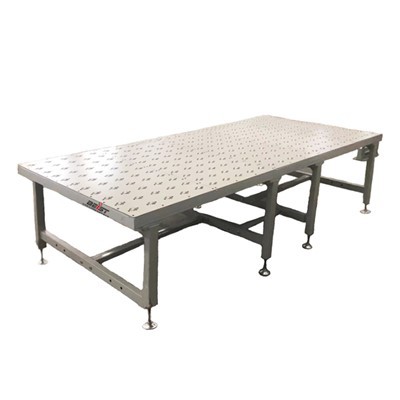
As a supplier of unpowered roller conveyors, we offer a range of products designed to meet different speed requirements. Our Ball Transfer Table For Wood Panel Handling is suitable for handling large and heavy wood panels. The ball transfer design allows for smooth and efficient movement of the panels, and the speed can be adjusted based on the incline and the characteristics of the panels.
Our Air Flotation Table Conveyor uses air to reduce friction between the product and the conveyor surface. This technology enables higher speeds and is ideal for transporting lightweight and fragile items.
The Industrial Air Table For Board Processing is another product in our portfolio. It is designed for board processing applications and can handle a variety of board sizes and weights. The air - cushioning effect ensures smooth and fast movement of the boards.
Contact Us for Procurement
If you are interested in our unpowered roller conveyors and want to discuss your specific requirements, we encourage you to reach out to us. Our team of experts is ready to assist you in selecting the right conveyor for your application and can provide detailed information on the maximum speed and other technical specifications. Whether you need a conveyor for a small - scale operation or a large - scale industrial facility, we have the solutions to meet your needs.