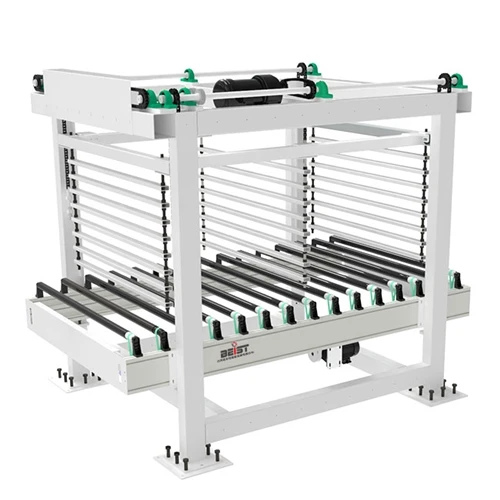
Measuring the lifting force of a Lifting Table with Forklift is a crucial aspect for both manufacturers and end - users. As a seasoned supplier of Lifting Table with Forklift, I understand the significance of accurate force measurement. It not only ensures the safety of operations but also guarantees the optimal performance of the equipment.
Understanding the Basics of Lifting Force
Before delving into the measurement methods, it's essential to understand what lifting force is. The lifting force of a Lifting Table with Forklift refers to the maximum weight that the table can safely and effectively lift. This force is determined by various factors such as the design of the hydraulic system, the strength of the structural components, and the quality of the materials used.
The hydraulic system is the heart of a Lifting Table with Forklift. It uses pressurized fluid to generate the force required for lifting. The pressure in the hydraulic cylinders is directly related to the lifting force. According to the principles of hydraulics, the force exerted by a hydraulic cylinder can be calculated using the formula (F = P\times A), where (F) is the force, (P) is the pressure in the cylinder, and (A) is the cross - sectional area of the piston.
Methods for Measuring Lifting Force
1. Using a Load Cell
One of the most accurate ways to measure the lifting force of a Lifting Table with Forklift is by using a load cell. A load cell is a transducer that converts force into an electrical signal. It can be placed between the load and the lifting surface of the table.
To use a load cell, first, ensure that the Lifting Table with Forklift is in a stable and level position. Then, place the load cell on the table and position the load on top of the load cell. As the table starts to lift the load, the load cell will measure the force exerted on it and convert it into an electrical signal. This signal can be read using a digital display or a data acquisition system.
The advantage of using a load cell is its high accuracy. It can measure the lifting force with a high degree of precision, allowing for accurate calibration of the Lifting Table with Forklift. However, load cells can be relatively expensive, and they require proper installation and maintenance.
2. Pressure Gauge Method
Another common method for measuring the lifting force is by using a pressure gauge. As mentioned earlier, the lifting force in a hydraulic system is related to the pressure in the hydraulic cylinders. By measuring the pressure in the cylinders, we can estimate the lifting force.
To use a pressure gauge, connect it to the hydraulic system of the Lifting Table with Forklift. Start the lifting operation and observe the pressure reading on the gauge. Using the formula (F = P\times A), we can calculate the lifting force. However, this method has some limitations. The formula assumes ideal conditions, and in reality, there may be losses due to friction, leakage, and other factors in the hydraulic system. So, the calculated force may not be as accurate as the measurement obtained using a load cell.
3. Comparative Testing
Comparative testing is a more practical but less accurate method. In this method, we use known weights to test the lifting capacity of the Lifting Table with Forklift.
First, select a set of weights with known masses. Start by placing the lightest weight on the table and gradually increase the weight until the table reaches its maximum lifting capacity. Observe the behavior of the table during the lifting process, such as whether it can lift the load smoothly, if there are any abnormal noises or vibrations.
This method is relatively simple and inexpensive. It can give a general idea of the lifting capacity of the Lifting Table with Forklift. However, it is not as accurate as the load cell or pressure gauge methods, and it does not provide a precise numerical value for the lifting force.
Importance of Accurate Lifting Force Measurement
1. Safety
Accurate measurement of the lifting force is crucial for safety. Overloading a Lifting Table with Forklift can lead to serious accidents, such as the table collapsing or the load falling. By knowing the exact lifting capacity, operators can ensure that they do not exceed the safe limit, reducing the risk of injury and property damage.
2. Performance Optimization
Measuring the lifting force also helps in optimizing the performance of the Lifting Table with Forklift. If the measured force is lower than the rated capacity, it may indicate a problem with the hydraulic system or the structural components. By identifying and fixing these issues, the table can operate at its optimal level, improving efficiency and reducing downtime.


Our Products and Services
As a supplier of Lifting Table with Forklift, we offer a wide range of high - quality products. Our Lifting Tables with Forklift are designed with advanced hydraulic systems and robust structural components to ensure reliable and efficient performance.
We also provide Conveyor Top Hydraulic Lift Table and Powered Roller Conveyor Lift Table, which are suitable for various industrial applications. Our commitment to quality and innovation has made us a trusted partner for many businesses.
Contact Us for Purchase and Negotiation
If you are interested in our Lifting Table with Forklift or other related products, we invite you to contact us for purchase and negotiation. Our experienced sales team is ready to assist you in selecting the right product for your specific needs and providing you with the best possible solution.
References
- Fluid Power Handbook, published by the Fluid Power Society.
- Engineering Mechanics: Statics and Dynamics, various editions, which provide in - depth knowledge of force analysis.
- Hydraulic System Design and Troubleshooting Guides, available from major hydraulic equipment manufacturers.