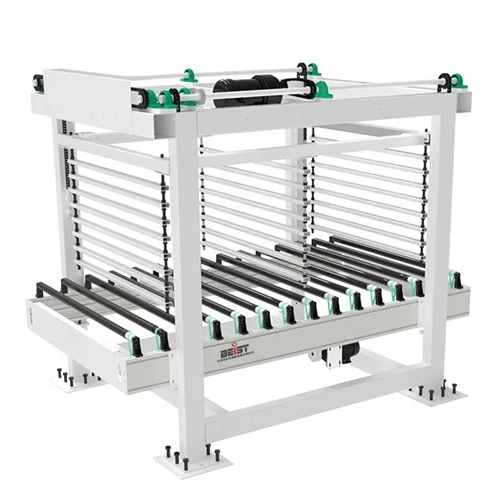
Are there any anti - static features on an E Shape Lift Table?
As a supplier of E Shape Lift Tables, I often get asked about the anti - static features of our products. In various industrial environments, static electricity can pose significant risks, such as attracting dust, causing damage to sensitive electronic components, and even triggering explosions in flammable and explosive atmospheres. Therefore, understanding whether an E Shape Lift Table has anti - static features is crucial for many customers.
The Basics of Static Electricity in Industrial Settings
Static electricity is generated when two materials come into contact and then separate. In industrial operations, the movement of objects, friction between different parts of machinery, and even the flow of air can all lead to the build - up of static charges. For example, when a pallet is being loaded or unloaded from a lift table, the friction between the pallet and the table surface can generate static electricity.
In environments where there are sensitive electronic components, a small static discharge can cause permanent damage to these components. In industries dealing with flammable materials, static electricity can be a major safety hazard. A spark caused by static discharge can ignite flammable gases or dust, leading to fires or explosions.


Anti - Static Features in E Shape Lift Tables
Conductive Materials
One of the most common ways to prevent static build - up on an E Shape Lift Table is by using conductive materials. Our E Shape Lift Tables are often constructed with conductive metals such as steel. Steel is a good conductor of electricity, which allows static charges to flow through the table and be safely grounded.
The frame of the E Shape Lift Table, which is usually made of high - quality steel, provides a conductive path for static electricity. When the table is in contact with the ground, the static charges can be dissipated, reducing the risk of static discharge.
Grounding Systems
Proper grounding is essential for anti - static protection. Our E Shape Lift Tables are equipped with grounding systems that ensure a reliable connection to the ground. A grounding cable is typically attached to the table, which is then connected to a grounding rod or a grounding point in the building's electrical system.
This grounding system allows any static charges that accumulate on the table to be quickly discharged to the ground. By maintaining a low - resistance path to the ground, the risk of static electricity build - up and subsequent discharge is significantly reduced.
Anti - Static Coatings
In addition to using conductive materials and grounding systems, we also apply anti - static coatings to some of our E Shape Lift Tables. These coatings are designed to reduce the surface resistance of the table, making it easier for static charges to dissipate.
Anti - static coatings can be applied to the tabletop surface, which comes into direct contact with the objects being lifted. These coatings work by either conducting the static charges or by reducing the friction between the table and the objects, which in turn reduces the generation of static electricity.
Importance of Anti - Static Features in Different Industries
Electronics Manufacturing
In the electronics manufacturing industry, where even the smallest static discharge can damage sensitive electronic components, anti - static features on E Shape Lift Tables are of utmost importance. Our E Shape Lift Tables with anti - static features ensure that the components being lifted and transported are protected from static damage.
For example, when assembling printed circuit boards, the E Shape Lift Table can be used to position the boards at the appropriate height. The anti - static features prevent static charges from building up on the table and the boards, reducing the risk of component failure.
Chemical and Pharmaceutical Industries
In the chemical and pharmaceutical industries, where there are often flammable and explosive substances, anti - static features are a must. Our E Shape Lift Tables with anti - static capabilities help to prevent static - induced fires and explosions.
When handling chemicals or pharmaceutical powders, the table's anti - static properties ensure that static electricity does not accumulate on the table or the containers, reducing the risk of ignition.
Comparing E Shape Lift Tables with Other Types of Lift Tables
Lifting Table with Forklift
The Lifting Table with Forklift is another type of lift table commonly used in industrial settings. While both the E Shape Lift Table and the Lifting Table with Forklift can be equipped with anti - static features, the E Shape Lift Table has some unique advantages.
The E Shape design of the lift table provides a more stable and balanced platform for lifting objects. This design also allows for easier access to the objects being lifted, which is especially useful in applications where there is limited space.
Conveyor Lifting Table with Forklift
The Conveyor Lifting Table with Forklift is used in applications where there is a need to integrate a conveyor system with the lift table. Similar to the other lift tables, anti - static features can be incorporated into the Conveyor Lifting Table with Forklift.
However, the E Shape Lift Table is more versatile in terms of its application. It can be used in a wider range of industries and for different types of lifting tasks. The anti - static features on our E Shape Lift Tables are carefully designed to meet the specific requirements of each application.
Contact Us for Your E Shape Lift Table Needs
If you are looking for an E Shape Lift Table with reliable anti - static features, look no further. Our company has been a leading supplier of E Shape Lift Tables for many years, and we are committed to providing high - quality products that meet the needs of our customers.
Whether you are in the electronics manufacturing, chemical, pharmaceutical, or any other industry, our E Shape Lift Tables with anti - static features can provide you with a safe and efficient lifting solution. Contact us today to discuss your specific requirements and to get a quote for your E Shape Lift Table.
References
- "Industrial Safety Handbook" by John R. Alston
- "Static Electricity in Industry: Detection and Control" by Peter J. Lawless